GREEN                           

     AND

        CLEAN

             POWER        

French River Land Company's Website!


French River Land Company's Home Page!

Poetry of Power

FRL History

Hydrolec Disassembly

Hydrolec Rebuild

Key Personnel

Machine Shop

News Page

Previous Pictures

Previous Pictures Two

Previous Pictures Three

Projects

For Sale

HYDROELECTRIC SITES:

Alternatives Hydro

Anasagunticook Lake Dam Replacement-    C.Fay & W.Fay

Appleton HEP-     Jim Lichoulas

Badger Pond Dam Removal

Senor Bonifettis' sites in Chile

Buttermilk Hydro

Chittendon Falls

Claytor Dam

Collins Bascule Dam

ESAC WORKS      July 1985

Fiske Mill

1852 Fourneyron

Golden Pond Hydro

Hunts Pond

Jaffery Fire Protection

Konkapot Creek

Lake May Pelton Wheel Removal

Livermore Falls

Martinsville Hydro

OSV

Shaker Mill Dam

Silk Knitters- Ron Macleod

South Village Dam

Sparhawk Mills

Tannery Pond

Turners Falls Generator Rewind

Valatie Falls

Valley Paper

USEFUL ENGINEERING:

Air Admission to Hydro Runners

The Banki Water Turbine Mockmoore and Merryfield

Barrel Stave Bearing Repair

Bishops Method- STABGM Program

Blade Pitting- Boving LTD 1930

Cavitation- Accelerated Research, Allis Chalmers Research

Cavitation & Vibration of a Draft Tube

Cavitation- Prevention & Reduction, Allis Chalmers Research

Causes & Effects of Cavitation in Hydraulic Turbines

Chain Turbine by: Nguyen Minh Duy

Chain Turbine Mechanics- Discussions with Duy

Characteristics of Modern Hydraulic Turbines-Chester Larner

Comparative Tests On Experimental Draft Tubes- C M Allen & I A Winter  1923

Design of an Overshot Waterwheel

(by Carl Weidner)

Design of Pelton Buckets

Design of Small Water Turbines for Farm and Small Communities

Design of the runner of a Kaplan turbine for small hydroelectric power plants: Timo Flaspöhler

Draft Tube Design

Draft Tubes of Hydro-Electric Stations by M. F. Gubin

Draft Tube Tests

Ejection into Tailraces of Hydropower Plants: S. M. Slisskii

Fall Increaser- Henry Ford

Fall Increaser Herschel Venturi Tube

Fall Increaser Moody Ejector Turbine

Fall Increaser Hydraulic Jump Apron

Feasibility Studies for Small Scale Hydropower Additions, A Guide Manual, US Army CORPS of Engineers

Flashboard Pins

Gatecase Design- Kovalev

Governor Theory for the Plant Operator

Graphics of Water Wheels- William Fox

Hydraulic Motors- M. Bresse & F. A. Mahan 1869

Hydraulic Turbines- Robert Long Daugherty

Hydraulic Turbines by Arnold Pfau

Hydraulic Turbines Gelpke & Van Cleve

Hydrokinetic Energy in Massachusetts- William D. B. Fay

Hydrostatic Beam Analysis

Impulse Turbines  by Ely Hutchinson

Kaplan Blade Design NACA Air Foil- Report No. 460

Kaplan Blade Design NACA Air Foil- Report No. 628

Kaplan Design- Kovalev

Kaplan Design Marko Kogovsek.xls

A Laboratory Study to Improve the Efficiency of Crossflow Turbines- N. Aziz & V. Desai

Meggering Generators

Meggering      Earth Resistance

Motors as Generators for Microhydro, Nigel Smith

Operation & Maintenance of Hydro-Generators

Out Gassing of Cross Flow Turbines

Parallel Operation of Turbines Analysis

Pelton Design- Daugherty

Powerhouse Design- Miniwatt Hydro

Powerhouse Design- Natick Dam

Power Plant Inspection

Rake-Leonard

Rake-Newport News

Rack Design-Chicopee-Olav Hotvedt

Rack Design- PHI- Bill Fay

Rack Design-PHI-Brian French

Rack Design-PHI-Ken Smith

Rack Design-ASCE

Rack Design- Hydraulic Institue of Munich

Rack Design-Flow Induced Vibrations

Selecting Hydraulic Reaction Turbines BUREC

Shafts- Kovalev

Shaft Couplings

Snows Improved Water Wheel Governor

Standard for Hydraulic Turbine and Generator Shaft Couplings and Shaft Runout Tolerances

Stoplog Design Calculation

Stoplog Structure Design Calculation

Stress Analysis of Hydraulic Turbine Parts, BUREC- F.O. Ruud

Some Fluid Flow Characteristics of a Cross Flow Type Hydraulic Turbine- Durgin & Fay

Tenth Census of the US, 1880, Water Power of the US, Part I- Professor Trowbridge

Tenth Census of the US, 1880, Water Power of the US, Part II- Professor Trowbridge

Tests on a Kaplan Hydraulic Turbine

Theoretical Conditions Related to an Open Channel Flow Linear Turbine- Ishida & Service

Theory of Turbines- De Volson Wood

Treatise relative to the Testing of Water-Wheels and Machinery, James Emerson 1879

Turbine Water-Wheel Tests- Robert Horton

Turgo, A High Speed Impulse Turbine- Paul Wilson

Vortices at Intakes

Water Hammer-Lorenzo Allievi-Text

Water Hammer-Lorenzo Allievi-Figures

Water Hammer-ASME Symposium 1933

Water Hammer _ Norman Gibson

Water Hammer-E.B.Strowger

Waterpower Engineering-Daniel Webster Mead

Water Wheel Design- Ken Smith

Weights

WHAMO

Wooden Penstocks

TRADE CATALOUGES:

Bradway Turbine  (progressive gate)

Brook Waterwheel

Charmilles Turbines

Christiana Machine (register gate)

Dayton Globe

Electric Machinery Company (EM)

English Pelton

ESAC

Essex Turbines

GE WW Vert Gen

GE Springbed Brg

Gilkes Turbines

GilkesWaterpower

Head Gate Hoists- S. Morgan Smith

Holyoke Hercules

Hunt Cat 29 A&B

Hunt cylinder

J & W Jolly       (cylinder gate)

Kingsbury  Brg

Leffel Bulletin 38

Leffel Bulletin 54

Leffel Hoppes Unit

Leffel Laboratory Unit

Leffel Miscellaneous

Lombard Direct-Connected Oil Pressure Governors Bulletin N0. 113 October 1st, 1912

Lombard Governor

Lombard Governor Company Type T Instruction Book

Lombard Governors for Waterwheels and Steam Engines-1902

Lombard Water Wheel Governors Catalouge 26

Pelton Wheel (1909)

Pelton Wheel (1925)

Ridgway Perfection Water-Wheel

Rodney Hunt

Samson PamK

Smith Bulletin 110

Smith Power Tables

Smith Kaplan

Smith Power

Smith Pelton

Smith Develop

Smith Turbines: Bulletin 105

Swain Turbine

Trump Hydraulic Turbines

Trump Turbines

Tyler Turbine

Vertical Shaft Water Wheel Driven Generators- General Electric

Wellman Seaver Morgan

Westinghouse Small Vertical Waterwheel-Driven A-C Generators, July 1944

Westinghouse WW Generators

Woodward Governor


Links:

Swiftriverhydro.com

damengineers.com

Smith Alternative Energy (www.smithtest.com)


Barrel Stave Bearing Repair Web Page

Many of the larger manufacturers of hydraulic turbines such as I.P. Morris, Newport News Shipbuilding and Wellman Seaver Morgan incorporated a barrel stave bearing to oppose the radial forces on the turbine main shaft. This bearing had long, thin, dove tailed, lignum vitae strips that were inserted in a cylindrical, cast iron housing. Once the strips were all inserted into the housing, the housing was placed on a boring mill and the wooden surfaces of the strips were bored to the diameter of the main shaft. Provisions were made to pump water between the shaft and the wood to provide lubrication. Many operators do not realize that at certain gate settings a Francis runner will create a vacuum on the crown of the runner. This sucks the water out of the lignum vitae bearing and burns the wood up. In order to provide lubrication of the wooden surface a dependable water supply must be provided.

    I first ran across this type of bearing at Consolidated Edison's Red Bridge Station. It is located on the Chicopee River in Wilbraham, MA. There are two 5 megawatt S. Morgan Smith units operating on 50 feet of head. We were called in to inspect Unit One because it was making load bumping noises. We found that the main shaft was quite loose. We could not find a way to adjust the bearing. It did not have a quarter block assembly with bronze adjusting screws. We removed the stuffing box and the wet end bearing. We found a barrel stave bearing that was worn out. We also discovered a very badly worn 13 inch diameter, main shaft. We created a split metal sleeve from a piece of pipe and welded it onto the damaged shaft. We installed new lignum vitae staves and reassembled the unit.

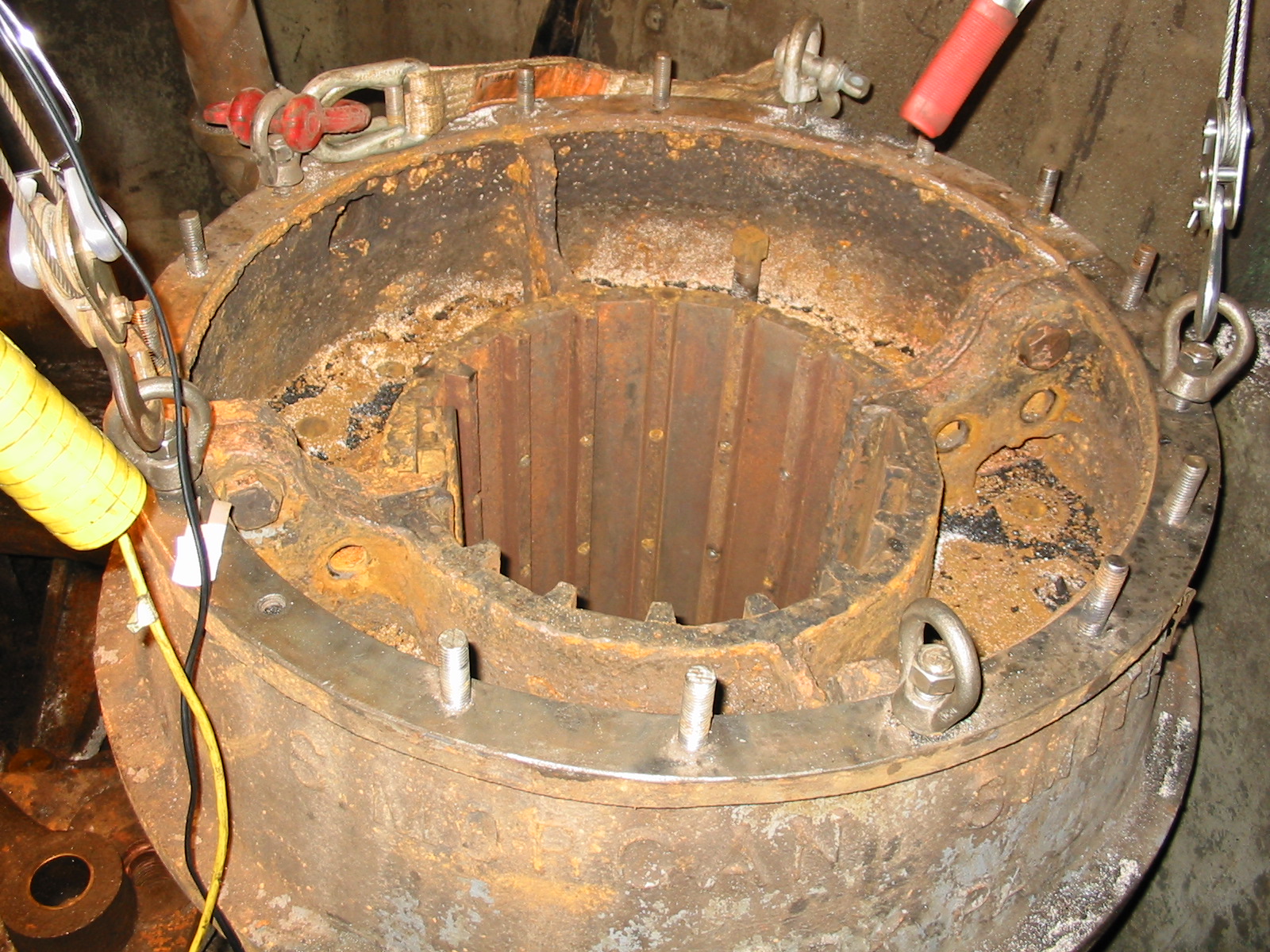
Red Bridge's barrel stave bearing housing with the wooden staves removed.
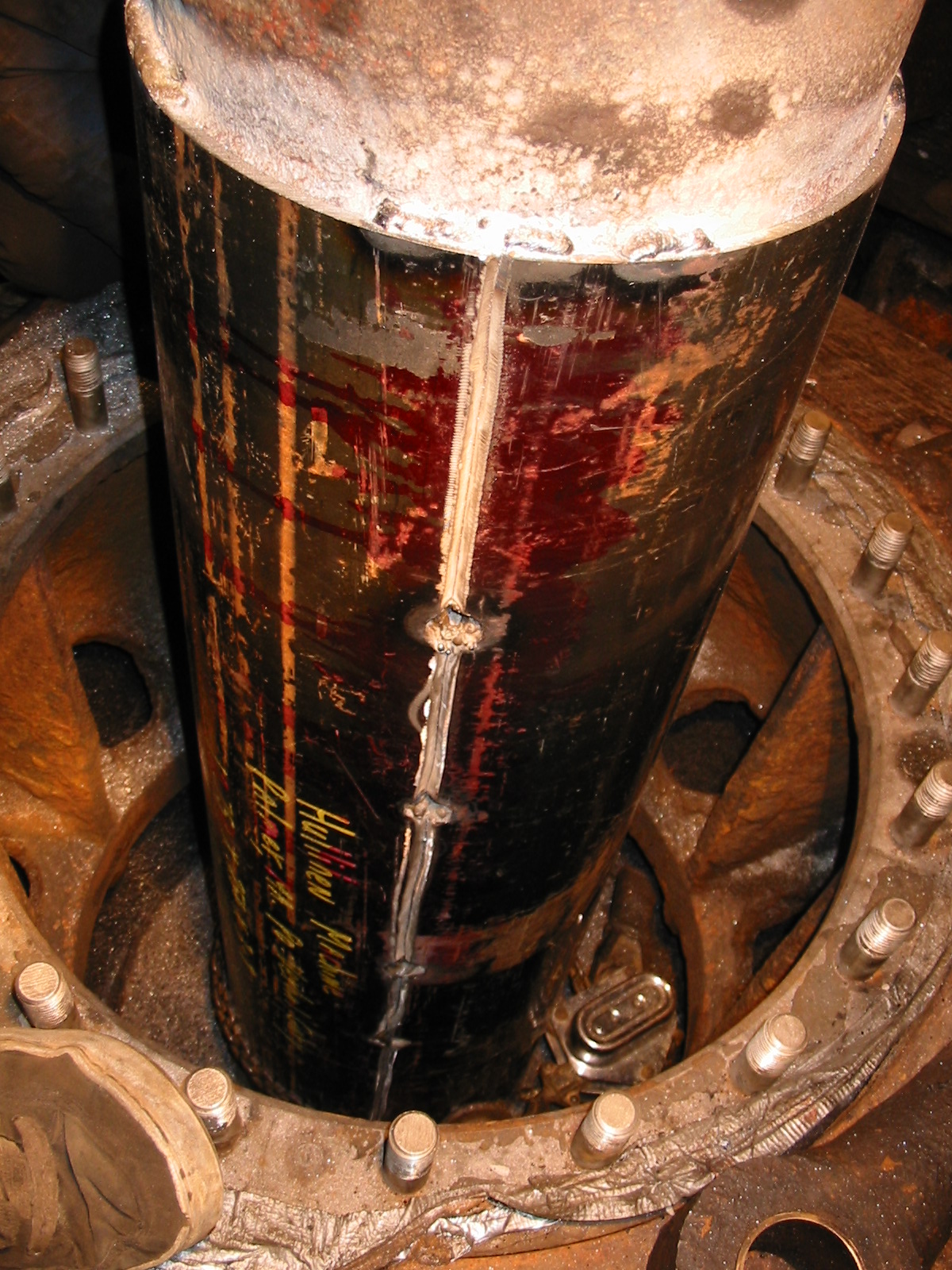
Installation of shaft sleeve at Red Bridge station

We recently had to repair the barrel stave bearing at the former Keith Paper Company in Turners Falls, MA. The following series of photos depict the process:
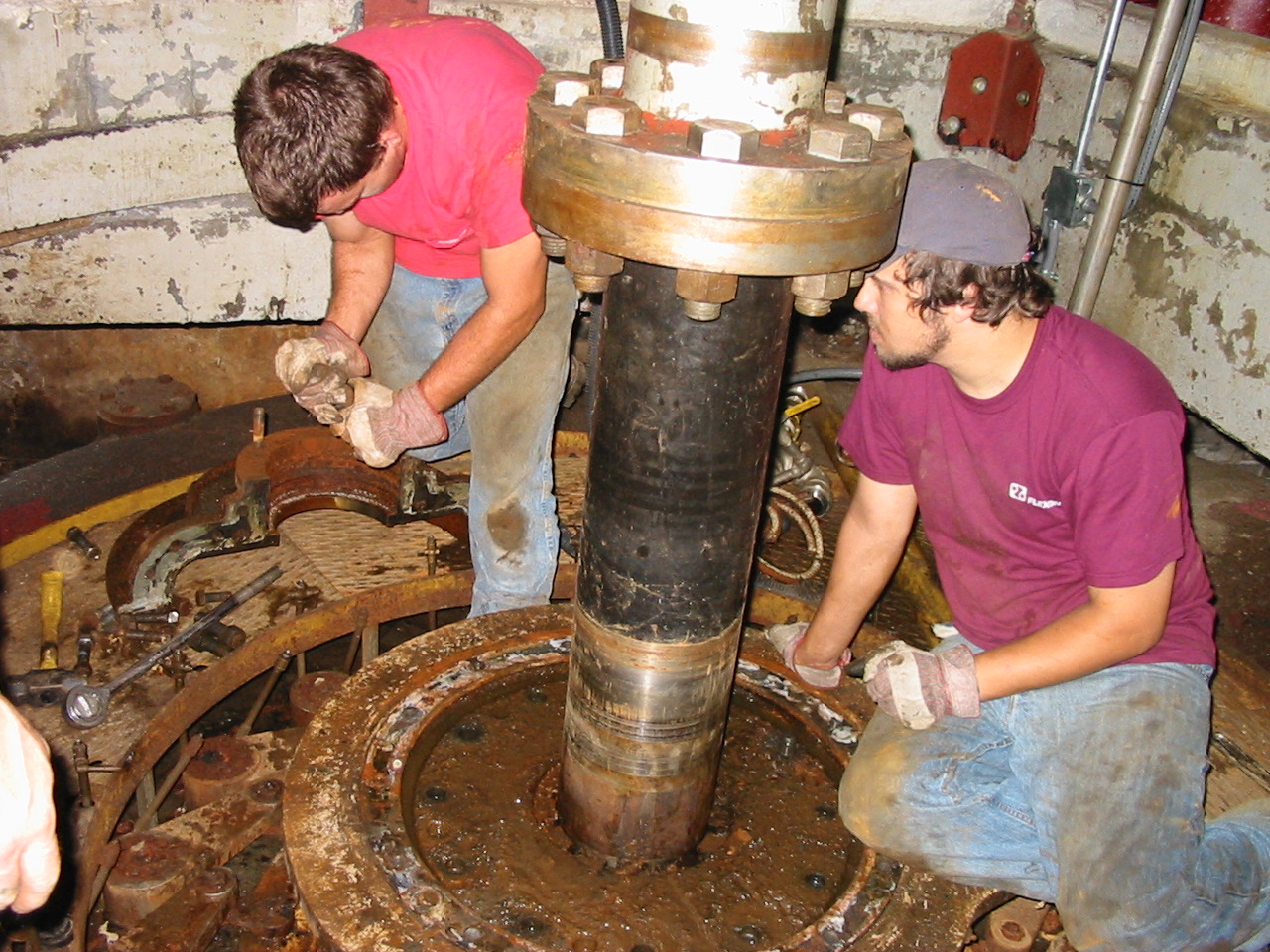
Here we have removed the stuffing box and we are looking at the top of the barrel stave bearing's housing. You can see the stuffing box gland at the top right. Notice the bell cranks that actuate the turbine wicket gates. If you look closely at the top of one of the bell cranks, you can see that it has been retro fitted with ring phetters.
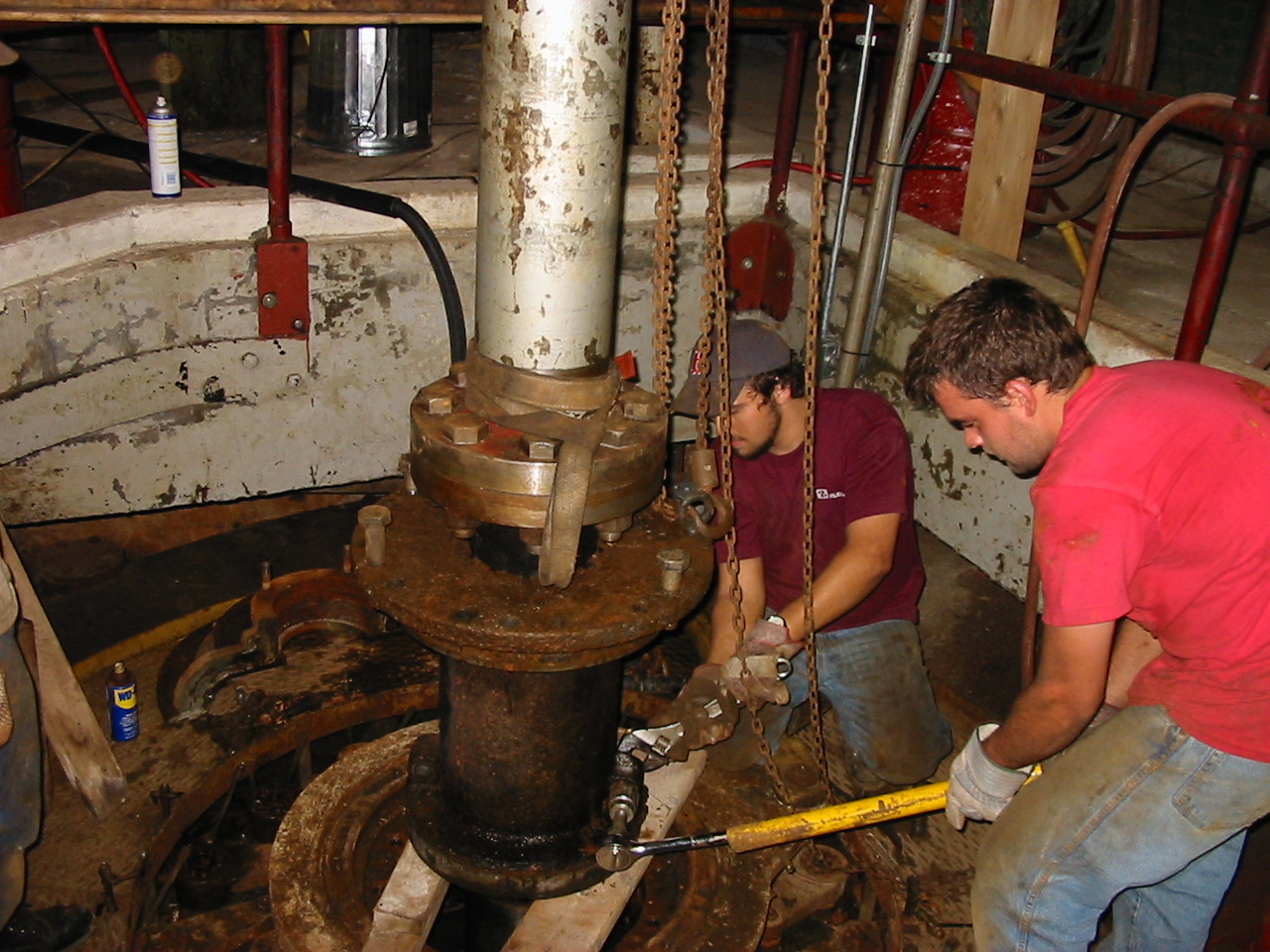
Ronnie Johnson and Cole have jacked the bearing housing out of the scroll case. They are removing the pinch bolts in order to split the bearing housing in preparation of its removal from the main turbine shaft.
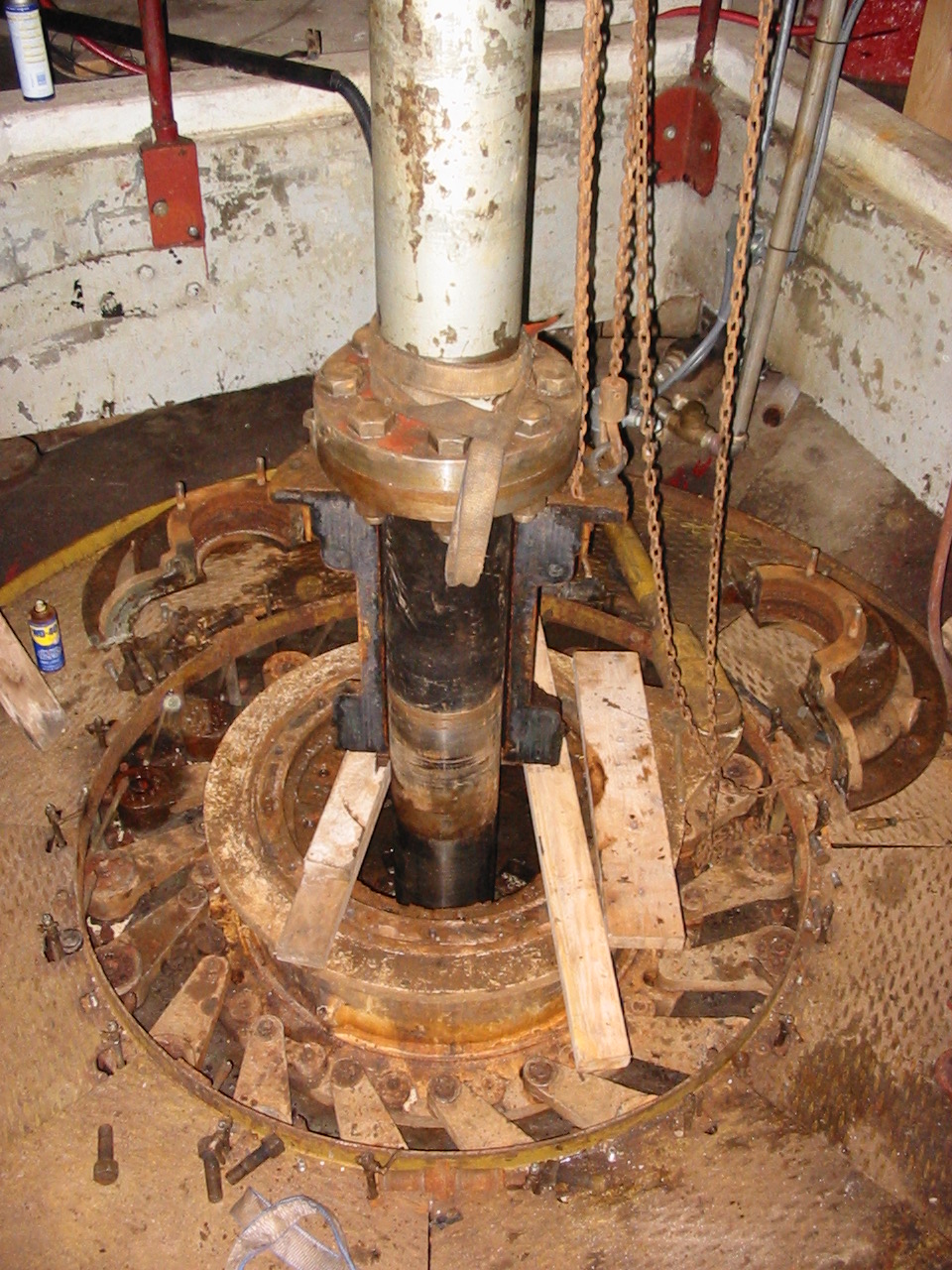
Here we have removed half of the bearing housing and we are lifting out the second half. Notice one half of the stuffing box is sitting to the right on the floor plates.
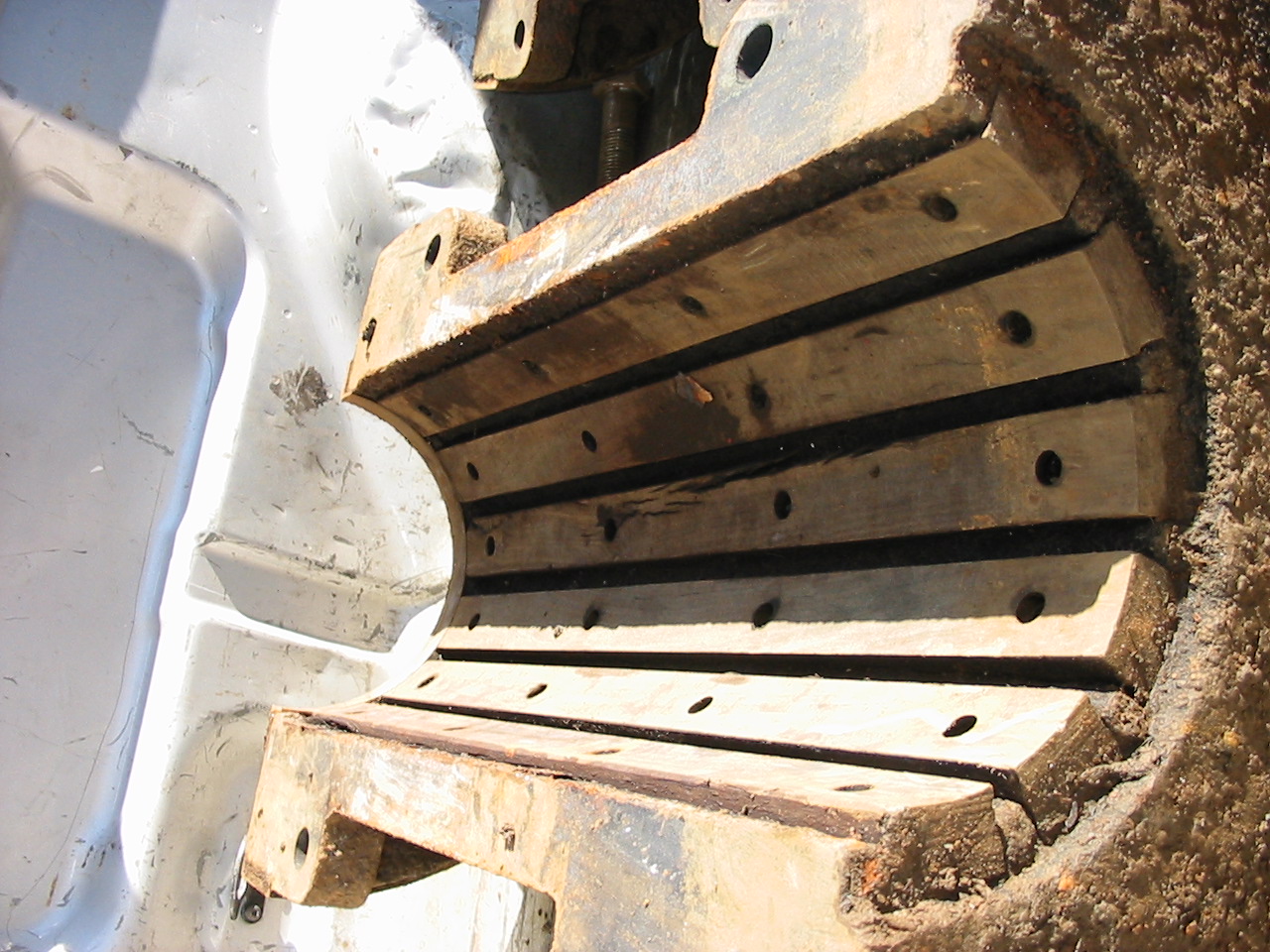
A view of the worn out bearing strips. These strips are non-adjustable. The round holes contain bronze screws that hold the strips in place. If you look closely at the top of a stripee the dove tailed shape.
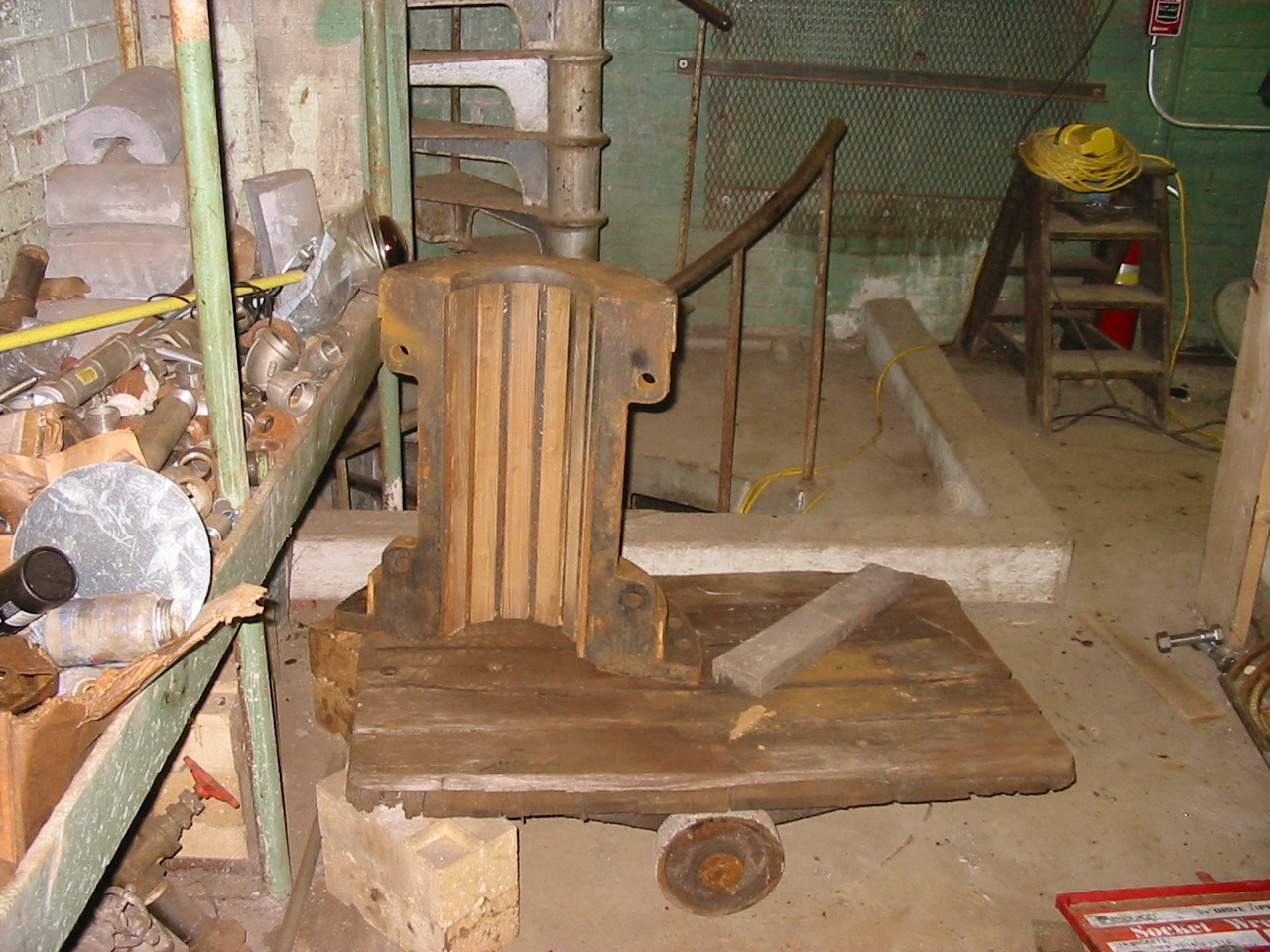
Another view of the barrel stave bearing.
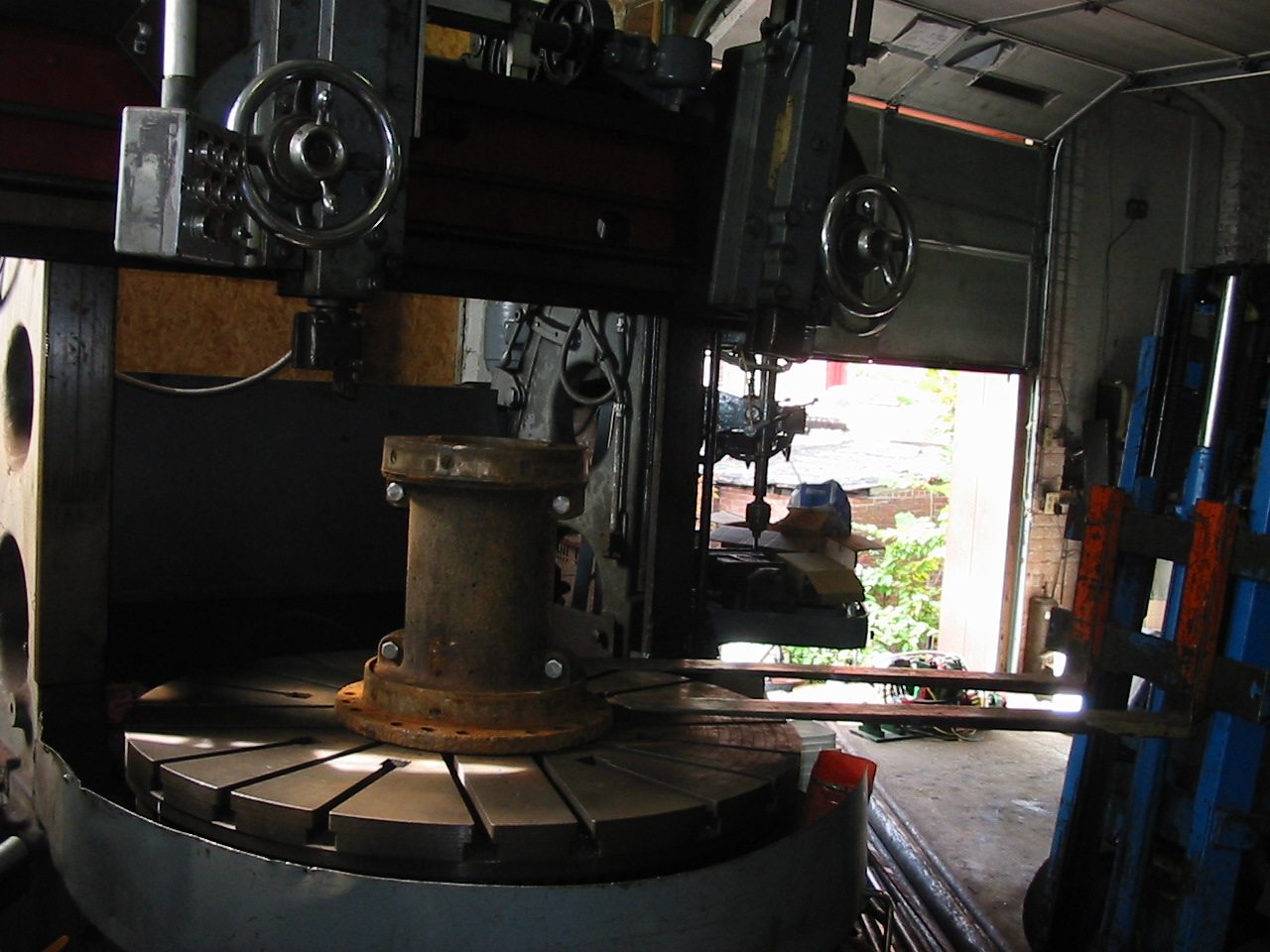
We have just lifted the completed bearing assembly onto the Bullard vertical turret lathe to be turned.
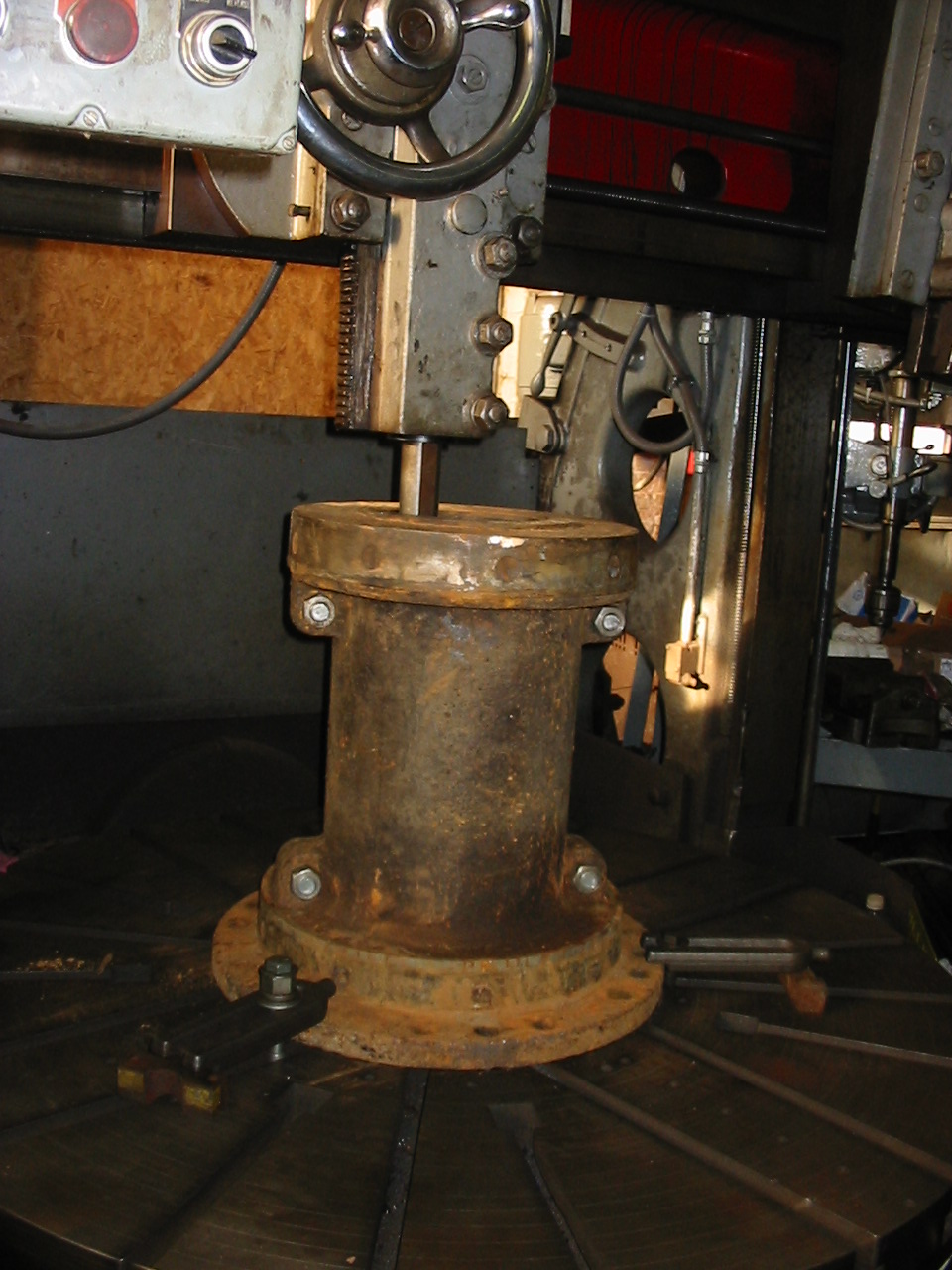
Here we have already inserted and screwed down the new strips. We have clamped the assembly onto the chuck of our 60 inch Bullard. The Wizard is about to bore the inside of the wooden strips to 8 inches internal diameter.
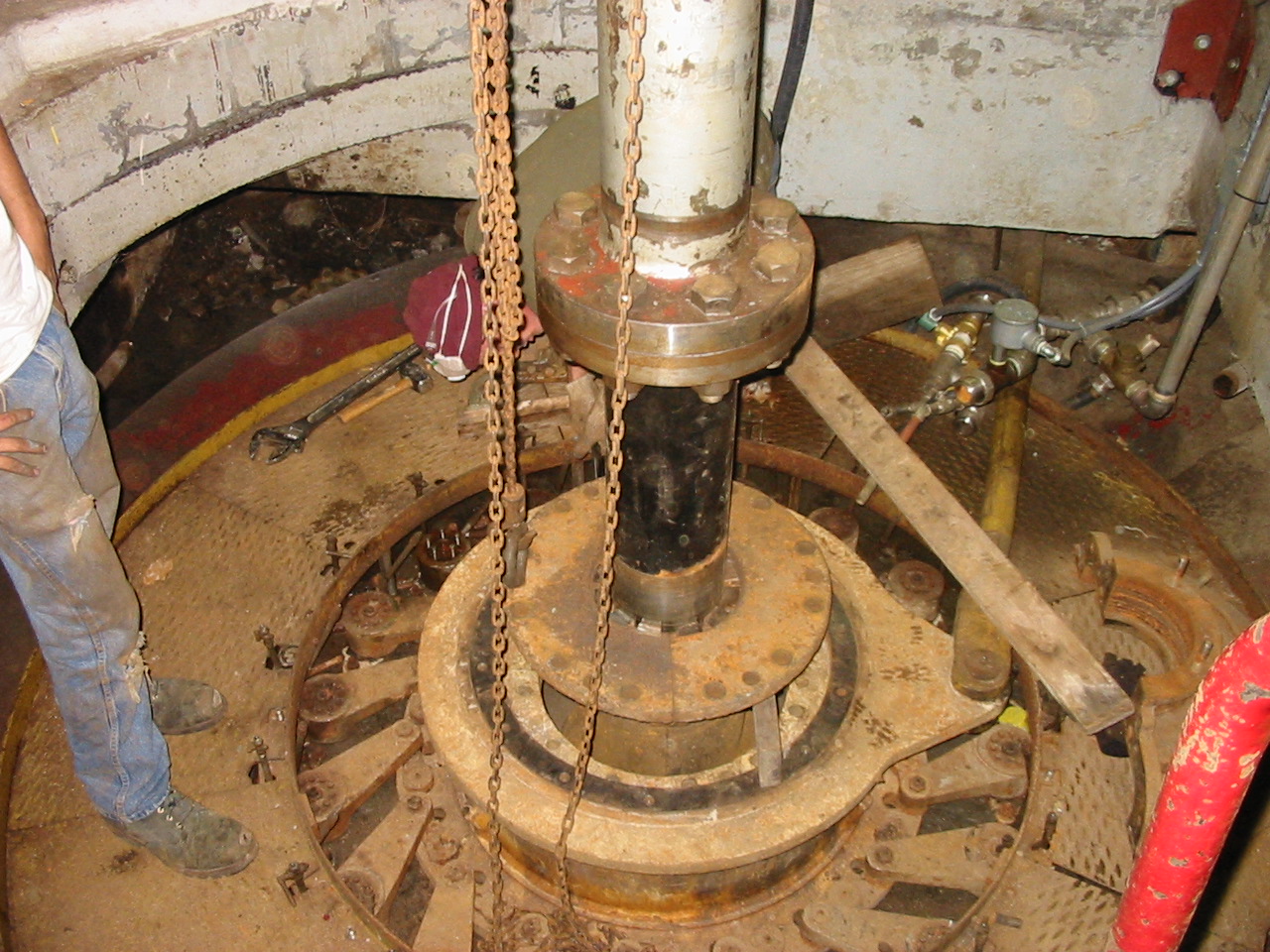


Micke Desrouche and Joe are lowering the bearing housing back into the scroll case. When we first installed the two halves of the bearing and tightened the pinch bolts the housing clamped solid to the shaft. We thought the bearing had been bored to the incorrect internal diameter. We quickly realized we were on a section of the shaft that had never been worn. We had to loosen the pinch bolts up. We were than able to lower the unit into its bore. Just as the lower set of pinch bolts were entering the scroll case, we tightened the lower pinch bolts. As we continued to lower the unit we tightened the rest of the pinch bolts.
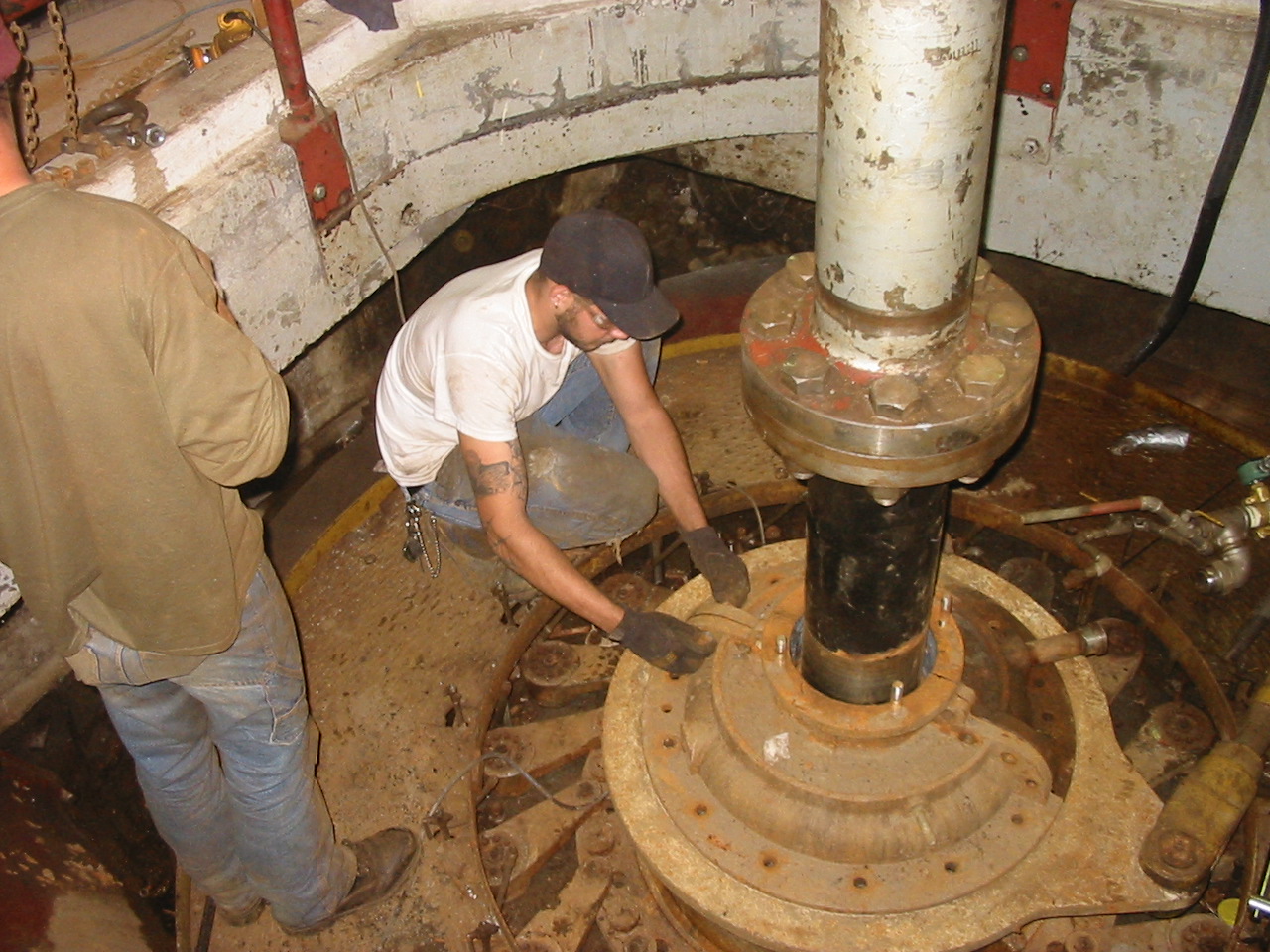
Here Joe is installing the stuffing box. Note the 2 inch stainless steel pipe that is used to flood the bearing stave chamber.
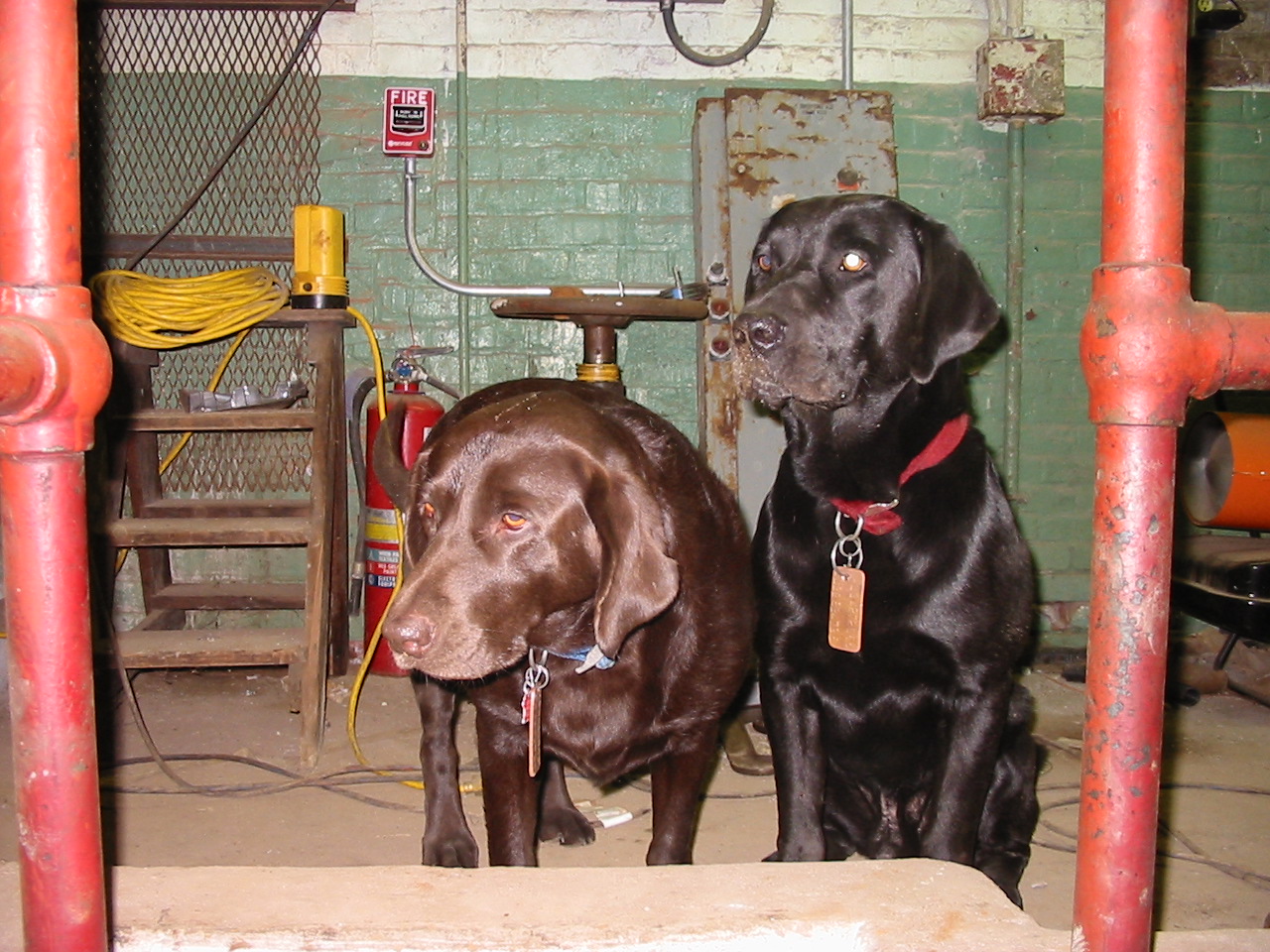
Here are our faithful supervisors. At first, they were barking out orders like a couple of dogs. By this time they were wondering when they could go home!!!